


Transparency has emerged as a defining characteristic of modern agricultural commerce. Consumers demand to know where their food comes from, how it was grown, and who handled it along the way. Businesses require visibility into supplier practices, product quality, and supply chain integrity. Regulators mandate comprehensive documentation and traceability. In this environment, opaque supply chains face increasing disadvantages while transparent operations create competitive differentiation and customer trust. This guide explores why transparency matters and how businesses can build transparent agricultural supply chains.
Traditional agricultural supply chains operated with minimal transparency. Buyers knew their immediate suppliers but had little visibility into upstream sources. Products moved through multiple intermediaries with limited documentation. Quality claims were difficult to verify. This opacity worked adequately in simpler times but creates significant problems in today's complex, globally connected markets.
Food safety incidents demonstrate transparency's importance dramatically. When contamination occurs, businesses with transparent supply chains can quickly trace affected products to their source, enabling targeted recalls that minimize waste and protect consumers. Companies with opaque supply chains face much broader, costlier recalls because they can't pinpoint contamination sources precisely.
Beyond crisis management, transparency delivers ongoing value through improved supplier accountability, enhanced quality consistency, stronger customer relationships, regulatory compliance, and premium pricing opportunities. These benefits compound over time, creating sustainable competitive advantages for transparent operations.
Traceability: The ability to track products through every stage of the supply chain—from farm or origin through processing, storage, transportation, and final delivery. Comprehensive traceability means knowing exactly where products came from, who handled them, what processes they underwent, and when each transaction occurred.
Documentation: Complete, accurate records of all supply chain activities. This includes purchase orders, quality certificates, laboratory test reports, phytosanitary certificates, transportation records, storage documentation, and handling logs. Digital documentation systems make these records easily accessible and verifiable.
Visibility: Real-time information about product location, condition, and status throughout the supply chain. Modern visibility systems enable stakeholders to monitor shipments continuously, receive updates on milestones, and access relevant documentation instantly.
Verification: Independent confirmation of supplier claims about product origin, quality, certifications, and handling practices. Verification transforms supplier assertions into validated facts through third-party audits, laboratory testing, and systematic checks.
Risk Mitigation: Transparent supply chains enable rapid problem identification and resolution. When quality issues arise, transparent systems help pinpoint causes quickly. When regulatory questions emerge, comprehensive documentation provides answers. This risk reduction protects business continuity and reputation.
A Chennai-based cashew exporter with comprehensive traceability systems faced a customer quality complaint about foreign matter in a shipment. Their transparent system immediately identified the specific processing batch, supplier farm location, and handling steps. Investigation revealed a temporary equipment malfunction at the processing facility. Because they could demonstrate the issue was isolated to one batch and had been corrected, the customer accepted a replacement shipment rather than terminating the relationship. Without transparency, this situation might have resulted in lost business and damaged reputation.
Quality Consistency: Transparency creates supplier accountability. When suppliers know their performance is tracked and documented, quality standards receive greater attention. Transparent systems reveal which suppliers consistently meet standards and which struggle, enabling informed supplier management decisions.
Customer Confidence: Buyers increasingly demand supply chain transparency. International customers especially require comprehensive traceability for food safety compliance and consumer disclosure. Transparent businesses can confidently provide the documentation and assurances customers need, winning business competitors with opaque operations cannot pursue.
Premium Pricing: Products with verified provenance and quality documentation often command price premiums. Organic certifications, fair trade documentation, and sustainability credentials all depend on transparent supply chains that verify claims. These premiums can be substantial—10-30% for certain commodities and markets.
Operational Efficiency: Transparent operations eliminate time wasted tracking down information. When customers inquire about shipments, comprehensive systems provide instant answers. When audits occur, organized documentation makes compliance demonstration straightforward. This efficiency reduces administrative costs while improving responsiveness.
Supplier Verification and Documentation: Transparency begins with knowing your suppliers thoroughly. Implement systematic supplier verification covering legal and business registration, facility capabilities and conditions, quality management systems, certifications and compliance, and past performance records. Maintain digital supplier profiles with all relevant documentation accessible in centralized repositories.
Batch and Lot Tracking: Assign unique identifiers to product batches throughout the supply chain. When raw materials arrive from suppliers, record batch numbers. When processing occurs, track which input batches contribute to output batches. When shipments depart, document which batches are included. This batch-level tracking enables precise traceability.
Digital Record Keeping: Replace paper-based records with digital systems that capture data at each supply chain step. Mobile applications enable field workers to record information immediately—when products are harvested, when quality inspections occur, when shipments are loaded. This real-time data capture improves accuracy while reducing documentation burdens.
Blockchain for Immutable Records: Blockchain technology creates tamper-proof transaction records that all supply chain participants can verify. When a farmer records harvest information on a blockchain system, that record cannot be altered later. When a processor documents quality testing, those results become permanent, verified records. While blockchain adoption is still emerging, pilot projects demonstrate its potential for creating trusted transparency.
IoT Sensors and Continuous Monitoring: Internet-of-Things sensors enable continuous monitoring of product conditions—temperature, humidity, location. For perishable agricultural commodities, this continuous monitoring verifies proper handling throughout cold chains. Automated data capture from sensors creates objective records that supplement manual documentation.
Step 1 - Map Your Supply Chain: Begin by mapping all current supply chain steps and participants. Document where products originate, who handles them at each stage, what processes occur, where products are stored, and how transportation happens. This mapping reveals transparency gaps and improvement opportunities.
Step 2 - Define Data Requirements: Determine what information must be captured at each supply chain stage. For agricultural commodities, this typically includes origin details (farm location, harvest date), quality parameters (grade, moisture content, testing results), processing information (batch numbers, processing date, facility), storage conditions (temperature logs, duration), and transportation details (carrier, route, timing).
Step 3 - Implement Digital Systems: Deploy digital platforms that capture required data systematically. Modern platforms like OMPOI provide mobile applications for field data capture, centralized databases for record storage, APIs for system integration, real-time dashboards for visibility, and automated reporting for compliance. These integrated systems transform fragmented information into comprehensive transparency.
Step 4 - Train Stakeholders: Supply chain transparency requires all participants to capture and share information properly. Provide training on why transparency matters, what information to capture and when, how to use digital tools effectively, and quality standards for data accuracy. Stakeholder buy-in and capability are essential for transparency success.
Step 5 - Verify and Audit: Implement regular verification to ensure transparency systems work as intended. Random audits confirm data accuracy, spot checks verify information captured properly, supplier assessments evaluate documentation quality, and system reviews identify improvement opportunities.
Supplier Resistance: Some suppliers resist transparency, viewing documentation requirements as burdensome or threatening. Overcome resistance by clearly communicating transparency benefits—improved business stability, access to premium markets, reduced disputes—and providing support for capability building. Start with willing suppliers and demonstrate value before expanding requirements.
Technology Adoption Barriers: Small suppliers especially may lack technology capabilities for digital data capture. Address this through user-friendly mobile applications requiring minimal training, cloud-based systems with no infrastructure requirements, and technical support and training programs. Modern systems designed for field use work even in areas with limited connectivity.
Data Privacy Concerns: Suppliers sometimes worry that sharing detailed information creates competitive vulnerabilities. Address concerns through clear data usage policies, access controls limiting who sees specific information, and contractual protections preventing misuse. Transparent businesses protect partner information while maintaining supply chain visibility.
Cost Considerations: Transparency systems require investment in technology, training, and processes. However, these costs are typically modest compared to benefits. Cloud-based platforms like OMPOI offer affordable subscription models that eliminate large upfront investments while delivering enterprise-grade transparency capabilities.
Coffee Supply Chain Transparency: Leading coffee brands now provide consumers with detailed provenance information—specific farm sources, farmer names, harvest dates, processing methods. This transparency creates powerful consumer connections and enables premium pricing. Digital platforms track coffee from individual farms through processing, export, and roasting, maintaining complete chain of custody documentation.
Organic Certification Traceability: Organic certification requires comprehensive traceability proving products maintained organic integrity throughout supply chains. Certified businesses track organic crops from certified farms, through certified processors, via documented transportation, to final buyers—maintaining complete separation from conventional products. This rigorous traceability enables organic premiums while ensuring consumer trust.
Export Compliance Documentation: International trade requires extensive documentation—phytosanitary certificates, certificates of origin, quality reports, fumigation records. Transparent exporters maintain digital documentation systems providing instant access to all required paperwork, streamlining customs clearance while demonstrating compliance.
Consumer preferences increasingly favor transparent supply chains. Surveys consistently show consumers willing to pay premiums for products with verified provenance and ethical sourcing. Younger consumers especially value transparency, making it essential for brands targeting millennial and Gen Z markets.
Smart labeling technologies—QR codes, NFC tags, blockchain-based apps—enable consumers to access detailed product information by scanning packages. This direct consumer access to supply chain information creates powerful brand differentiation and trust.
Regulations increasingly mandate supply chain transparency. Food safety regulations require traceability for rapid recall execution. Import regulations demand documentation proving product origins and quality. Sustainability regulations require supply chain disclosure for environmental and social compliance.
The EU's upcoming deforestation regulations exemplify this trend—requiring companies to prove agricultural commodities don't contribute to deforestation through comprehensive supply chain traceability. Similar regulations are emerging globally, making transparency not optional but mandatory for market access.
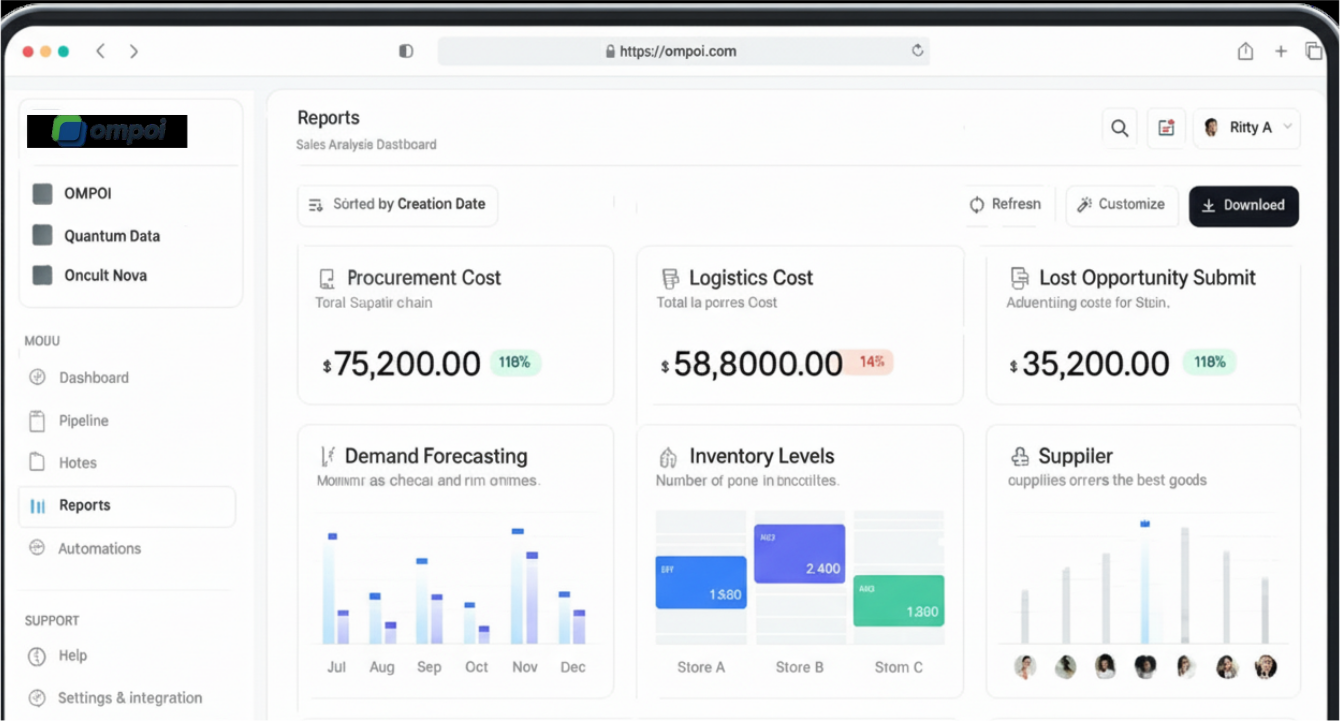
Modern digital platforms make transparency practical and affordable for businesses of all sizes. OMPOI's approach exemplifies this by providing supplier verification systems documenting capabilities and certifications, batch tracking throughout supply chain stages, digital documentation with centralized storage and access, real-time visibility dashboards showing shipment status and conditions, and automated compliance reporting for regulatory requirements.
These integrated platforms eliminate the technical barriers that previously made comprehensive transparency accessible only to large enterprises with substantial IT resources.
Forward-thinking businesses view transparency not as compliance burden but as competitive differentiator. Transparent operations access markets competitors cannot enter, command premium pricing through verified quality claims, build stronger customer relationships through confidence and trust, operate more efficiently with better information and accountability, and manage risks more effectively through early problem identification.
These advantages compound over time, creating durable competitive positions that opaque competitors struggle to match.
Begin transparency initiatives by identifying your transparency drivers—customer requirements, regulatory compliance, quality improvement, or market differentiation. Assess current state honestly, identifying transparency gaps and improvement priorities.
Start with one commodity or supply chain where transparency delivers clear value. Implement digital tracking and documentation for this pilot scope. Demonstrate results—improved quality, customer satisfaction, efficiency gains—to build organizational support for broader transparency initiatives.
Expand systematically to additional commodities and suppliers, learning from pilot experiences. Involve suppliers as partners in transparency journey, providing support and recognizing leaders who embrace transparency effectively.
Transparency will only become more important as technology advances, consumer expectations rise, and regulations expand. Emerging technologies like satellite monitoring of farm practices, DNA testing for product origin verification, and advanced sensors for condition monitoring will make supply chain transparency even more comprehensive and verifiable.
Businesses building transparent operations today position themselves strategically for this transparent future, while companies delaying transparency initiatives will face increasing disadvantages as transparency becomes standard market expectation.
Supply chain transparency transforms from nice-to-have to competitive necessity in modern agricultural commerce. The combination of consumer demand, regulatory requirements, and quality management needs makes transparency essential for businesses serious about long-term success.
Building transparent supply chains requires systematic approaches covering supplier verification, batch tracking, digital documentation, and stakeholder collaboration. While implementation requires commitment and investment, the benefits—risk reduction, quality improvement, customer trust, premium access, operational efficiency—far exceed costs.
Modern digital platforms make comprehensive transparency accessible to businesses of all sizes, eliminating technical and cost barriers that previously limited transparency to large enterprises. The question is no longer whether transparency matters, but how quickly businesses can implement it to capture competitive advantages.
Ready to build transparency into your agricultural supply chain? Discover how OMPOI's integrated platform provides the tools and capabilities needed to create comprehensive supply chain visibility and traceability.






Create comprehensive traceability and visibility with OMPOI's integrated transparency platform.