


In agricultural commodity trading, your supplier relationships can determine your success or failure. A reliable supplier ensures consistent quality, timely delivery, and compliance with regulations. An unreliable one creates costly problems that damage your business reputation. This guide walks you through the essential steps to verify agricultural suppliers and establish quality standards that protect your business interests.
Every year, businesses lose millions of rupees due to inadequate supplier verification. The problems manifest in various ways: substandard products that customers reject, delayed shipments that miss market windows, documentation errors that create customs issues, and even fraudulent suppliers who disappear after receiving advance payments.
Beyond financial losses, poor supplier selection damages your reputation. When you deliver inferior products to customers, they remember. When shipments arrive late disrupting their operations, they find alternative suppliers. In competitive markets, reputation is everything, and your suppliers directly impact how customers perceive your business.
Business Registration Documents: Start by verifying that suppliers are legitimate registered businesses. In India, this means confirming their company registration with the Ministry of Corporate Affairs for companies, or appropriate registration for proprietorships and partnerships. Request and verify Certificate of Incorporation, Partnership Deed or registration certificates, and GST Registration certificates.
Cross-reference these documents against official databases. The GST portal allows verification of GST numbers. The MCA website enables verification of company details. Don't simply accept photocopies—verify authenticity through official channels.
FSSAI Licensing: For food commodities, FSSAI (Food Safety and Standards Authority of India) licensing is mandatory. Verify the supplier holds appropriate FSSAI licenses for their business scale—Basic Registration for small operators, State License for medium businesses, or Central License for large manufacturers and exporters.
Check that the license covers the specific products they supply. FSSAI licenses specify product categories, and suppliers cannot legally trade products outside their licensed scope. The FSSAI website enables online verification of license validity.
Import-Export Compliance: If sourcing from exporters or import-export traders, verify their IEC (Import Export Code) issued by DGFT (Directorate General of Foreign Trade). This code is essential for cross-border trade. Additionally, for specific commodities, check for memberships in relevant commodity boards—Spices Board, Tea Board, Coffee Board, or Agricultural and Processed Food Products Export Development Authority (APEDA).
A supplier's financial health directly impacts their ability to fulfill commitments reliably. Request and review bank references from their primary banking partner, credit ratings from agencies like CRISIL or ICRA when available for larger suppliers, and financial statements for the past 2-3 years including balance sheets and profit & loss statements.
Look for warning signs: frequent changes in banking relationships, declining revenues or increasing losses over consecutive years, high debt-to-equity ratios suggesting financial stress, and negative working capital indicating cash flow problems.
For new suppliers, consider starting with smaller test orders before committing to large volumes. This approach limits exposure while you assess their reliability and financial stability through actual transactions.
Facility Assessment: Whenever possible, conduct physical audits of supplier facilities. Evaluate processing equipment condition and capacity, storage facilities including temperature and humidity control for sensitive commodities, quality control infrastructure and testing capabilities, hygiene and sanitation standards, and workforce size and skill levels.
During facility visits, observe operations during working hours to see actual processes rather than prepared demonstrations. Check if the facility matches the capacity claims suppliers make. A supplier claiming to process 100 tons monthly should have equipment and space consistent with that volume.
Capacity Verification: Request evidence of current production volumes through sales records, dispatch documentation, or customer references. Ensure suppliers can meet your volume requirements without overextending their capabilities. An overcommitted supplier facing capacity constraints often compromises quality or delivery timelines to manage multiple customers.
ISO Certifications: International quality standards provide valuable verification of supplier quality systems. Key certifications for agricultural commodities include ISO 22000 (Food Safety Management), ISO 9001 (Quality Management Systems), HACCP (Hazard Analysis and Critical Control Points), and organic certifications like NPOP, USDA Organic, or EU Organic for organic products.
Don't just ask if certifications exist—request copies of certificates and verify their authenticity with issuing bodies. Check expiry dates and scope of certification. A certificate might cover only certain products or facilities, not the supplier's entire operation.
Internal Quality Processes: Beyond formal certifications, evaluate suppliers' internal quality control processes. Do they have documented standard operating procedures? How frequently do they test product quality? What parameters do they monitor? Who is responsible for quality control, and what authority do they have?
Request to review quality control records from recent production batches. Consistent testing and documentation indicate systematic quality management. Absence of records or irregular testing suggests quality may be inconsistent.
Customer References: Request references from current customers, particularly those purchasing similar products or volumes as you plan to order. Contact these references directly and ask specific questions about quality consistency, on-time delivery performance, how the supplier handles problems or complaints, communication and responsiveness, and whether they would recommend the supplier to others.
Be cautious of suppliers who refuse to provide references or only offer vague contact information. Legitimate businesses with good track records willingly provide verifiable references.
Market Reputation: Research suppliers' reputation within the industry through trade associations and commodity boards, industry forums and online communities, other businesses in your network, and exhibition or trade show participation history. Suppliers actively engaged with industry bodies generally demonstrate professionalism and commitment to standards.
Sample Evaluation: Before committing to bulk orders, always evaluate product samples. Request samples that represent the actual product you'll receive, not specially selected premium samples. Evaluate samples against your specifications for size and grading, color and appearance, moisture content, foreign matter, damage and defects, and taste and aroma for relevant commodities.
Laboratory Testing: For critical parameters, conduct independent laboratory testing. Don't rely solely on supplier-provided test reports. Third-party testing verifies aflatoxin levels in nuts, pesticide residues, heavy metal contamination, microbiological safety, and nutritional composition if relevant.
The cost of lab testing is minimal compared to the risk of receiving bulk shipments of substandard products. Many exporters and large buyers make lab testing mandatory for all new suppliers and random testing for established suppliers.
Traceability Systems: Verify that suppliers maintain proper traceability records. Can they trace products back to source farms or processors? Do they maintain batch records linking specific shipments to production dates and inputs used?
Traceability is increasingly important for food safety, regulatory compliance, and customer demands. Many international buyers now require complete supply chain traceability, and suppliers without robust systems face market access limitations.
Documentation Standards: Assess suppliers' documentation capabilities by reviewing sample documents including commercial invoices, packing lists, phytosanitary certificates, quality test reports, and certificates of origin.
Errors in documentation create customs delays and additional costs. Suppliers who consistently produce accurate, complete documentation demonstrate attention to detail and professionalism.
Labor Standards: Evaluate suppliers' labor practices particularly if you have customers with social compliance requirements. Check for child labor policy and enforcement, fair wages and working conditions, worker safety measures, and compliance with local labor laws.
Many international buyers conduct social audits of suppliers, and non-compliance can result in immediate termination of business relationships. Even if your current customers don't require it, social compliance is becoming standard expectation.
Environmental Standards: Assess environmental practices including waste management and disposal, water usage and conservation, pesticide and chemical usage records, and efforts toward sustainable practices.
Environmental compliance protects against regulatory penalties and reputational damage while meeting growing customer demand for sustainable supply chains.
Develop a standardized verification checklist covering all critical areas. Your checklist should include:
Assign responsibility for completing each verification step. Document findings systematically. This creates a record you can reference when making supplier decisions and provides evidence of due diligence if problems arise.
Not every supplier requires the same verification depth. Apply risk-based thinking: higher value orders justify more thorough verification, new suppliers require more scrutiny than established partners, critical products affecting your core business warrant detailed assessment, and suppliers in regions with known compliance issues need enhanced verification.
For high-risk situations, consider hiring professional inspection agencies or consultants to conduct comprehensive supplier audits. The investment in professional verification pays for itself by preventing costly supplier problems.
Verification isn't a one-time activity. Implement ongoing monitoring systems tracking quality performance metrics, on-time delivery rates, documentation accuracy, complaint and resolution history, and compliance with contractual terms.
Conduct periodic re-verification of critical suppliers annually or bi-annually. Update verification records when suppliers undergo significant changes like facility relocations, ownership changes, or expansion into new product lines.
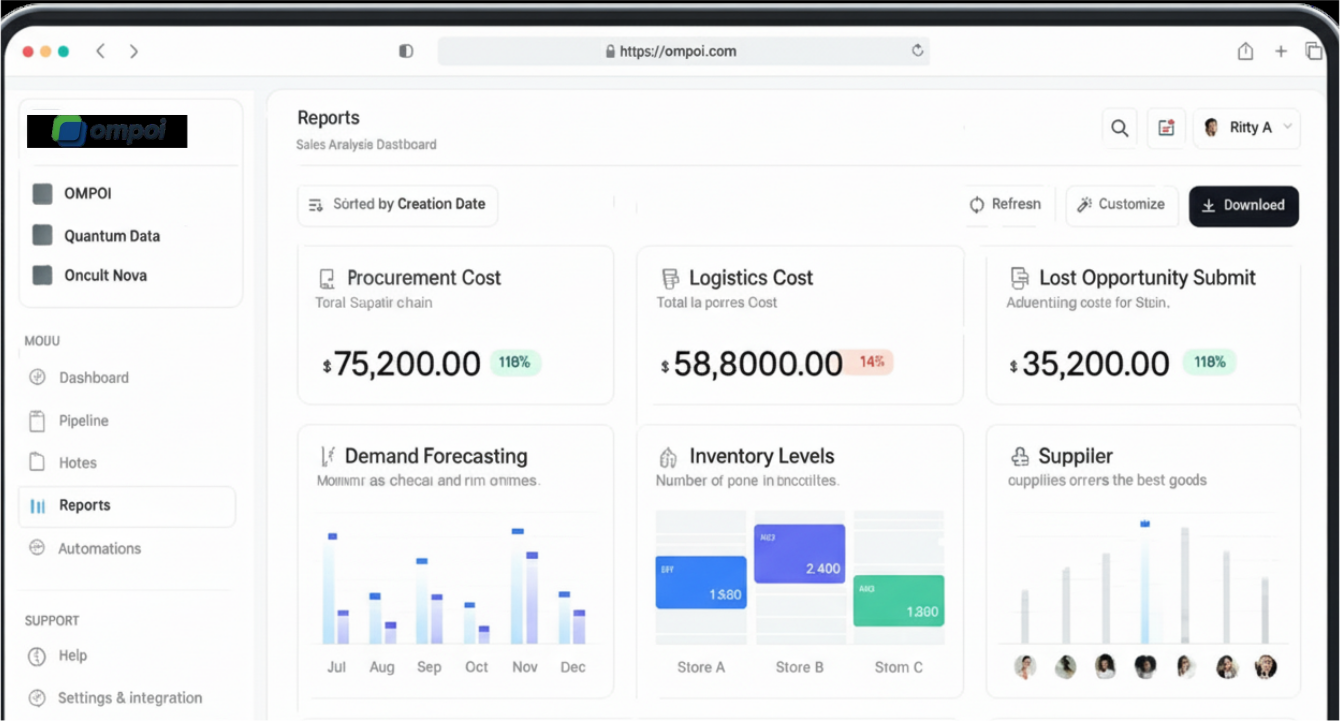
Modern platforms streamline supplier verification through centralized document management storing all verification records in accessible digital repositories, automated compliance tracking with alerts for certificate expirations, performance dashboards showing supplier metrics at a glance, and collaborative verification workflows enabling team members to complete verification steps efficiently.
OMPOI's platform includes built-in supplier verification tools that guide users through comprehensive verification processes, maintain digital records, and provide visibility into supplier performance over time.
Learn to recognize warning signs during supplier verification:
Any of these red flags warrants additional scrutiny or reconsideration of the supplier relationship.
Once you've verified suppliers meeting your standards, invest in building strong relationships. Communicate expectations clearly, provide feedback on performance, pay promptly per agreed terms, and treat suppliers as partners rather than adversaries.
Strong supplier relationships built on verified quality standards create competitive advantages. Preferred suppliers prioritize your orders, accommodate reasonable requests, and proactively communicate about potential issues.
Thorough supplier verification protects your business from quality problems, delivery failures, compliance issues, and financial losses. While comprehensive verification requires time and effort upfront, it prevents far more costly problems later. The systematic approach outlined in this guide—covering legal verification, financial assessment, production capability, quality systems, past performance, and ongoing monitoring—provides the foundation for reliable supplier relationships.
In today's competitive agricultural commodity markets, businesses that excel at supplier verification gain significant advantages through consistent product quality, reliable delivery, and compliance with customer requirements. Digital platforms like OMPOI simplify verification processes while providing the tools needed to maintain high supplier standards over time.
Ready to source from verified, quality-focused suppliers? Discover how OMPOI's comprehensive verification system connects you with 300+ pre-verified agricultural commodity suppliers across India.






Connect with 300+ KYC-verified agricultural suppliers on OMPOI's trusted marketplace.