


Agricultural commodity prices change constantly, influenced by weather patterns, harvest cycles, global demand, currency fluctuations, and geopolitical events. In this volatile environment, businesses making procurement decisions with outdated information risk paying inflated prices or missing favorable buying opportunities. Real-time pricing intelligence transforms this challenge into a strategic advantage, enabling data-driven decisions that optimize costs and improve profitability.
Traditional agricultural procurement often operates in information darkness. Buyers call multiple suppliers seeking quotes, but these quotes represent individual perspectives rather than true market conditions. By the time you've collected enough quotes to make comparisons, market prices may have shifted. This information lag creates several problems.
First, you might pay above-market rates simply because you lacked visibility into competitive pricing. A quote of ₹900 per kg for cashew kernels might seem reasonable, but real-time market data showing average prices at ₹840 would reveal you're overpaying by 7%—a significant margin that directly impacts profitability.
Second, without price trends visibility, you can't identify optimal purchase timing. Agricultural commodities follow predictable seasonal patterns, with prices typically lower during harvest seasons and higher during scarcity periods. Buyers with real-time intelligence time purchases to capitalize on favorable pricing windows.
Third, negotiation power suffers without market intelligence. When suppliers quote prices, you need objective benchmarks to evaluate fairness and negotiate effectively. Real-time data provides this ammunition, enabling confident pushback on inflated quotes with market evidence.
Current Market Rates: Real-time systems aggregate pricing data from multiple sources—commodity exchanges, verified supplier quotes, completed transactions, government market reports—to provide accurate current market rate estimates. Instead of relying on individual supplier quotes, you see what the broader market is trading at right now.
Price Trend Analysis: Understanding current prices gains context from historical trends. Real-time systems show how today's prices compare to last week, last month, and last year. This trend context reveals whether current prices represent good value or if waiting might yield better rates.
Regional Price Variations: Agricultural commodity prices vary by region based on production concentrations, transportation costs, and local supply-demand dynamics. Real-time intelligence captures these variations, showing price differences between Kerala, Karnataka, Maharashtra, and other regions. This visibility enables strategic sourcing from cost-advantaged locations.
Quality-Based Pricing: Different quality grades command different prices. Real-time systems track pricing across quality grades—showing, for example, that cashew W180 trades at premiums of 35-40% over W320. Understanding these quality-price relationships helps optimize procurement strategies based on your product requirements.
Verified Supplier Networks: Platforms like OMPOI aggregate real-time quotes from verified supplier networks. When 300+ suppliers post pricing for various commodities, the platform can calculate reliable market averages and price ranges, filtered by region, quality grade, and quantity.
Transaction Data: Completed transactions provide the most accurate pricing intelligence because they reflect actual market clearing prices, not just asking prices. Platforms tracking transactions can show what products actually sold for, providing definitive market validation.
Commodity Exchanges: Where available, commodity exchange data provides transparent price discovery. While not all agricultural products trade on exchanges, those that do benefit from public pricing transparency.
Government Market Reports: Agricultural market committees (APMCs) publish daily market reports showing prices for various commodities. While not always real-time, these official sources provide valuable benchmark data.
Industry Networks: Professional networks and trade associations often share pricing information among members, creating collective market intelligence that benefits all participants.
Quote Evaluation: When suppliers provide quotes, immediately compare them against real-time market data. If a quote falls within the market range, it's likely fair. Quotes significantly above market warrant negotiation or alternative supplier consideration. This comparison transforms quote evaluation from guesswork to data-driven assessment.
Optimal Purchase Timing: Real-time data combined with historical patterns reveals optimal purchase windows. For seasonal commodities, buying during harvest gluts when supply peaks and prices dip maximizes value. Price intelligence shows when these favorable windows are opening, enabling strategic timing.
Budget Planning: Annual budget planning requires price forecasts for raw materials. Real-time systems with historical data can project likely price ranges for upcoming months, improving budget accuracy. Instead of simple assumptions or hoping prices stay flat, use data-driven forecasts.
Supplier Negotiations: Armed with real-time market data, negotiations shift from adversarial haggling to collaborative problem-solving. When you can show suppliers that their quotes exceed market rates by specific percentages, supported by objective data, constructive pricing discussions become possible.
Seasonal Cycles: Most agricultural commodities follow predictable annual price cycles tied to harvest seasons. Prices typically decline during harvest as supply floods markets, then gradually increase during off-seasons as inventory depletes. Real-time systems overlay seasonal patterns onto current prices, showing whether today's rates are typical for this time of year.
Weather Impacts: Adverse weather events—droughts, floods, unseasonal rains—affect crop yields and consequently prices. Real-time intelligence incorporating weather data and crop condition reports can anticipate price impacts before they fully materialize in market quotes.
Export Demand: International demand significantly influences domestic prices for export commodities. Real-time systems tracking export inquiries, international price trends, and currency movements provide early indicators of domestic price direction.
Government Policies: Policy changes—export restrictions, import duties, minimum support prices, subsidies—immediately impact market prices. Real-time intelligence systems monitor policy announcements and rapidly update price forecasts to reflect new market conditions.
Pattern Recognition: Machine learning algorithms excel at identifying complex patterns in vast datasets. Applied to agricultural pricing, AI can detect subtle correlations between variables that human analysts miss—relationships between weather patterns in growing regions and price movements, connections between international commodity prices and domestic rates, or the impact of logistics disruptions on regional pricing.
Predictive Forecasting: Beyond showing current prices, AI-powered systems forecast future price movements. By analyzing historical patterns, seasonal trends, current market conditions, weather forecasts, and numerous other variables, predictive models estimate likely price ranges for coming weeks or months. These forecasts aren't guarantees but provide probability-based guidance for decision-making.
Anomaly Detection: AI systems can identify unusual price movements that might signal emerging market changes. Sudden price spikes or drops trigger alerts, prompting investigation into causes—supply disruptions, quality issues, policy changes, or market manipulation. Early awareness of anomalies enables proactive response.
Personalized Insights: Machine learning can tailor intelligence to your specific needs. If you primarily purchase certain qualities from particular regions, the system learns your preferences and highlights pricing information most relevant to your operations, reducing information overload.
Price Alerts: Configure automated alerts notifying you when prices hit target levels. If you're targeting cashew purchases at ₹850/kg or below, the system alerts you immediately when market prices drop to that level, enabling timely action on favorable pricing.
Dashboard Integration: Incorporate pricing intelligence into daily procurement workflows through dashboard displays showing current market rates, trend charts, and price alerts at a glance. This constant visibility keeps procurement teams informed without requiring active searching for information.
Quote Request Optimization: When issuing quote requests to suppliers, reference current market data to set realistic expectations. This transparency reduces back-and-forth negotiation and accelerates procurement cycles.
Performance Tracking: Compare your actual purchase prices against market averages to track procurement efficiency. Consistently purchasing within 2-3% of market averages indicates effective procurement. Persistent premiums suggest opportunities for supplier diversification or negotiation improvement.
Cashew Kernels: Cashew pricing varies significantly by grade (W180, W210, W240, W320, etc.) and origin (India, Vietnam, Africa). Real-time intelligence tracking all these variations enables optimal sourcing decisions—when to buy premium grades versus standard, when Vietnamese imports become cost-competitive with domestic sourcing, and how seasonal processing cycles affect availability and pricing.
Spices: The spice market features extreme volatility driven by monsoon impacts on production, international demand fluctuations, and quality variations. Real-time intelligence helps navigate this volatility by highlighting optimal purchase timing and identifying fair pricing for different quality grades.
Pulses: Pulse prices respond to government import policies, domestic production levels, and international markets. Real-time systems tracking all these factors provide comprehensive market understanding, enabling strategic procurement decisions.
Oilseeds and Edible Oils: These commodities often trade on formal exchanges with transparent pricing, supplemented by real-time intelligence from processor networks and port import data. Combined intelligence creates comprehensive market visibility.
Data Quality: Price intelligence is only valuable if underlying data is accurate and representative. Quality systems verify data sources, cross-reference multiple inputs, and filter outliers. OMPOI's approach of using verified supplier networks and actual transaction data ensures high data quality.
Regional Coverage: Comprehensive intelligence requires broad geographic coverage. Systems relying on single-region data provide incomplete pictures. Multi-region supplier networks create truly national price visibility.
Granularity: Generic commodity pricing lacks actionable specificity. Effective intelligence differentiates between quality grades, processing types, certification status (organic, conventional), and packaging formats. This granularity enables precise decision-making.
Timeliness: "Real-time" intelligence that updates weekly isn't truly real-time in fast-moving markets. Systems updating multiple times daily or continuously provide genuine real-time value, especially during volatile periods.
Cost Leadership: Consistent access to favorable pricing creates cost advantages over competitors lacking similar intelligence. Even small percentage improvements in procurement costs compound significantly across annual volumes, boosting profitability and competitive positioning.
Customer Value: Lower procurement costs enable competitive customer pricing or improved margins. Both strategies strengthen market position—either gaining market share through price competitiveness or improving financial performance through better margins.
Strategic Planning: Reliable price intelligence enables confident long-term planning. When considering capacity expansion, new product development, or market entry, accurate cost forecasts reduce uncertainty and improve decision quality.
Risk Management: Price intelligence helps manage financial risk. If forecasts indicate significant price increases, you might increase inventory levels, lock in forward contracts, or adjust customer pricing proactively rather than reactively absorbing cost shocks.
Price intelligence gains power when combined with other market data:
Integrated intelligence platforms combining all these dimensions provide comprehensive market understanding that drives optimal decisions across the procurement value chain.
OMPOI's pricing intelligence system aggregates data from its network of 300+ verified suppliers across India, capturing real-time quotes and completed transactions. Machine learning algorithms analyze this data to calculate market averages, price ranges, and trends across commodities, regions, and quality grades.
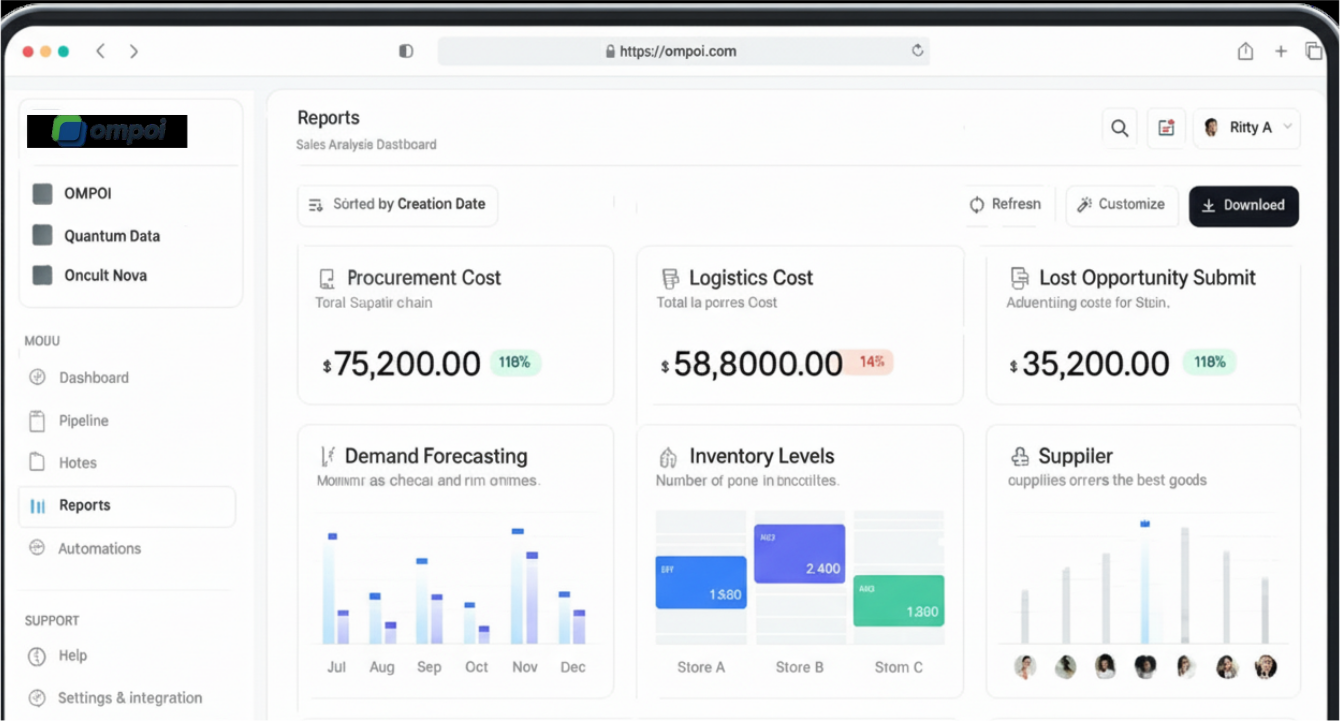
Users access this intelligence through intuitive dashboards showing current market rates, historical trends, regional comparisons, and predictive forecasts. Customizable alerts notify buyers when prices hit targets or significant market movements occur. Integration with the broader OMPOI platform means pricing intelligence directly informs sourcing decisions—when you post requirements, the system suggests appropriate budget ranges based on current market data.
This integrated approach eliminates the gap between intelligence and action. You're not just informed about markets—you're empowered to act on intelligence immediately through the same platform.
Begin by identifying your top commodities by value or volume—these deliver the highest intelligence ROI. Track market prices for these priority items, comparing your actual purchase prices against market benchmarks. This analysis reveals whether you're achieving competitive procurement or leaving money on the table.
Establish target price ranges based on market data and historical patterns. Configure alerts notifying you when markets enter favorable zones. Train procurement teams to reference real-time data when evaluating quotes and negotiating with suppliers.
As comfort and competence grow, expand intelligence usage to additional commodities and integrate forecasts into budget planning and strategic decisions.
Emerging technologies continue advancing price intelligence capabilities. Satellite imagery and remote sensing increasingly enable crop yield prediction months before harvest, providing early price indicators. Blockchain technology creates transparent, tamper-proof transaction records that improve price discovery. IoT sensors monitoring storage levels provide real-time inventory data influencing market pricing.
These advances make real-time intelligence increasingly sophisticated and accurate, further widening the competitive gap between businesses leveraging modern intelligence and those relying on traditional information methods.
Real-time pricing intelligence transforms agricultural procurement from reactive quote comparison to strategic, data-driven decision-making. The combination of current market rates, historical trends, predictive forecasts, and actionable alerts empowers businesses to optimize costs, improve negotiation outcomes, and time purchases strategically.
In commodity markets where price movements of 5-10% are common, intelligence-driven procurement improvements of even 3-5% generate substantial value. For businesses serious about procurement excellence, real-time pricing intelligence isn't a luxury—it's a competitive necessity.
Ready to leverage real-time market intelligence for smarter procurement decisions? Discover how OMPOI's AI-powered pricing intelligence platform provides the data and insights you need to optimize agricultural commodity sourcing.






Make data-driven procurement decisions with OMPOI's AI-powered pricing intelligence platform.