

Blog
November 15, 2025
Pricing Intelligence

In the volatile world of agricultural commodity trading, having accurate pricing intelligence can mean the difference between profit and loss. Traditional pricing methods rely on historical data and human intuition, but artificial intelligence is revolutionizing how businesses forecast prices and make procurement decisions. This comprehensive guide explores how AI-powered pricing intelligence is transforming agricultural commodity trading.
Agricultural commodity prices are influenced by numerous factors: seasonal variations, weather patterns, global demand, currency fluctuations, geopolitical events, and supply chain disruptions. Traditional pricing methods struggle to account for all these variables simultaneously, often leading to suboptimal purchasing decisions.
Buyers face constant uncertainty: Should they purchase now or wait for prices to drop? Is the current quote competitive? How will seasonal trends affect availability and pricing next month? These questions have historically been answered through experience and market intuition, but AI now offers data-driven insights.
Machine Learning Algorithms: Modern AI systems analyze years of historical pricing data, identifying patterns that human analysts might miss. These algorithms consider multiple variables simultaneously—seasonal trends, regional production data, export statistics, currency movements, and even weather forecasts—to generate accurate price predictions.
Real-Time Market Analysis: AI systems continuously monitor market conditions, processing thousands of data points every hour. When significant price movements occur, the system alerts buyers and provides context about what's driving the change. This real-time intelligence enables businesses to act quickly on favorable pricing opportunities.
Predictive Analytics: Perhaps the most powerful aspect of AI pricing intelligence is its ability to forecast future price movements. By analyzing historical patterns and current market conditions, AI models can predict price trends for the coming weeks and months with remarkable accuracy. This helps procurement teams plan their purchasing strategies more effectively.
Optimal Purchase Timing: A Mumbai-based spice exporter used AI pricing intelligence to identify that cardamom prices typically drop by 8-12% in the post-harvest season (November-December). By timing their bulk purchases accordingly and using predictive alerts, they reduced their annual procurement costs by ₹45 lakhs.
Budget Planning: Food manufacturers need to plan budgets months in advance. AI-powered price forecasts help them estimate raw material costs more accurately, reducing budget variance from 25% to less than 8%.
Negotiation Power: Armed with real-time market data and price benchmarks, buyers can negotiate more effectively with suppliers. One cashew processor reported that having AI-backed price intelligence gave them confidence to push back on inflated quotes, ultimately securing 11% better pricing.
OMPOI's pricing intelligence system combines multiple data sources to provide comprehensive market insights:
Data Collection: The platform aggregates pricing data from 300+ verified suppliers across India, government agricultural market statistics, international commodity exchanges, and logistics cost indices. This comprehensive dataset ensures pricing recommendations reflect true market conditions.
Machine Learning Models: OMPOI employs multiple specialized algorithms—time series forecasting for seasonal trends, regression models for price correlation analysis, and neural networks for complex pattern recognition. These models are continuously trained on new data to improve accuracy.
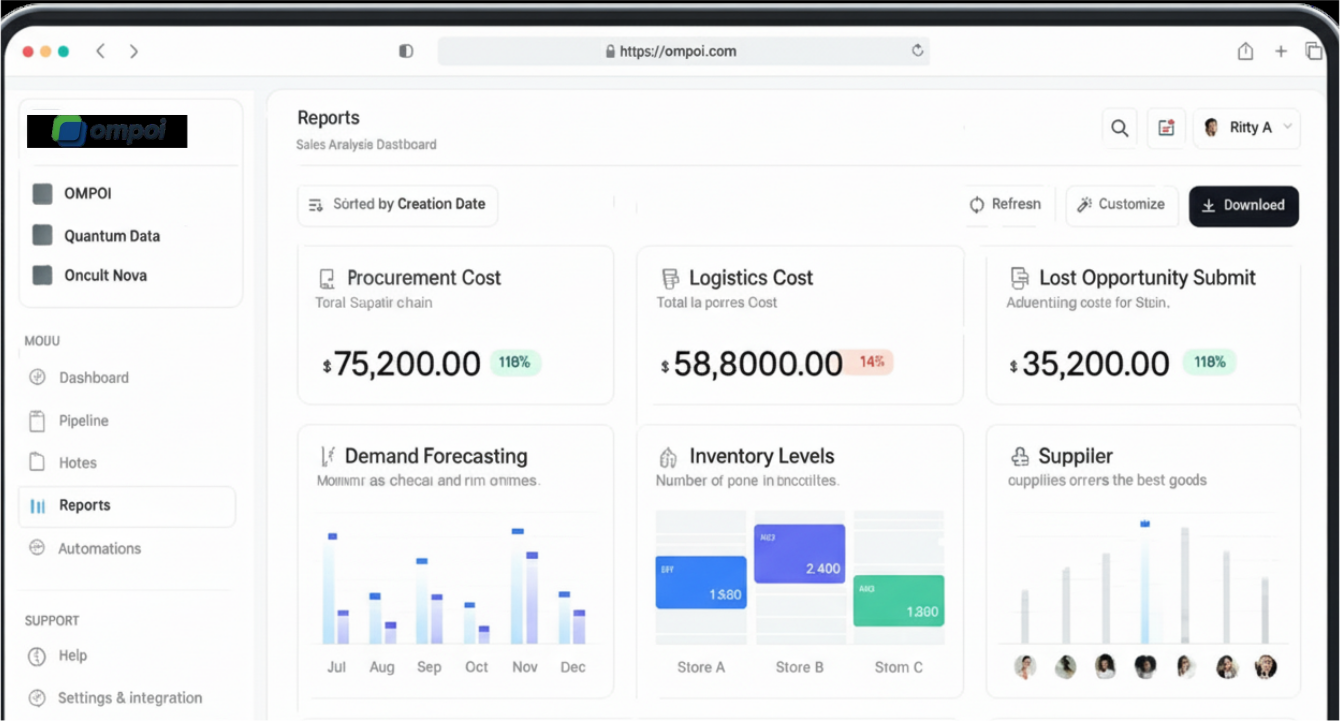
User-Friendly Dashboard: Complex AI analysis is presented through intuitive visualizations. Users see clear price trend charts, confidence intervals for forecasts, and actionable recommendations without needing to understand the underlying algorithms.
AI pricing predictions aren't crystal balls—they're probability-based forecasts that provide guidance for decision-making. A typical AI price forecast might indicate that cashew kernel W320 prices are 75% likely to remain between ₹850-₹890 per kg over the next 30 days, with a 15% chance of dropping below ₹850.
These probabilistic forecasts help businesses make risk-informed decisions. If you're comfortable with moderate risk, you might wait for potential price drops. If you need certainty for production planning, you'd purchase at current rates. The key is having data-driven insights rather than making decisions in a vacuum.
Agricultural commodities exhibit strong seasonal patterns, and AI excels at identifying and quantifying these trends. For example, AI analysis of cashew pricing reveals:
Understanding these patterns helps buyers plan annual procurement calendars that optimize costs while ensuring consistent supply.
AI pricing intelligence is most valuable when integrated into broader procurement strategies:
Dynamic Inventory Management: Use price forecasts to adjust inventory levels. When AI predicts price increases, consider increasing stock. When forecasts suggest price drops, maintain leaner inventory and purchase closer to need.
Multi-Sourcing Decisions: AI helps evaluate trade-offs between single-supplier reliability and multi-supplier price competition. If price volatility is predicted, locking in contracts with preferred suppliers might make sense. During stable periods, competitive bidding could maximize savings.
Forward Contracts: For businesses that can commit to future purchases, AI forecasts help determine when forward contracts offer advantages. If predictions suggest 15% price increases over six months, a forward contract at current rates could generate significant savings.
AI pricing intelligence doesn't just track commodity prices—it also analyzes the relationship between quality grades and pricing. For cashew kernels, AI might reveal that premium grades (W180, W210) command 35-40% premiums over standard grades (W320), but this premium varies seasonally.
During harvest season, premium grade availability increases and premiums compress to 28-30%. Understanding these dynamics helps businesses optimize their product mix—perhaps purchasing premium grades during harvest for better value, and standard grades during off-season when premiums are extreme.
For exporters and businesses engaged in international trade, AI pricing intelligence tracks correlations between Indian domestic prices and international markets. Currency fluctuations, international demand patterns, and competitor pricing in other origins (Vietnam, Brazil, Africa) all influence optimal pricing strategies.
OMPOI's AI system monitors these global factors, alerting users when international market conditions create export opportunities or when imported inputs become cost-competitive with domestic sources.
AI pricing models improve continuously as they process more data. OMPOI's system tracks prediction accuracy, comparing forecasts against actual outcomes. Current accuracy rates for 30-day price forecasts exceed 82%, and the system automatically adjusts its models when accuracy drops, ensuring predictions remain reliable.
Users can also provide feedback on price predictions, helping the system learn from real-world experience. If a predicted price drop doesn't materialize due to unexpected supply disruptions, this information refines future models.
While AI systems require substantial data, individual transaction details remain confidential. OMPOI's pricing intelligence uses aggregated, anonymized data to generate market insights. Your specific purchase prices, volumes, and supplier relationships are never shared with competitors or other users.
Implementing AI pricing intelligence doesn't require technical expertise. Modern platforms like OMPOI provide:
Start by monitoring prices for your top 3-5 commodities by volume or value. As you become comfortable with the insights, expand to your full product portfolio.
AI pricing intelligence continues evolving. Emerging capabilities include:
Satellite Imagery Analysis: AI systems are beginning to analyze satellite imagery of agricultural regions to estimate crop yields before harvest, providing even earlier price predictions.
Weather Pattern Integration: Advanced models incorporate weather forecasts and climate patterns to predict supply disruptions and price impacts months in advance.
Social and Political Risk Analysis: AI is learning to process news and social media to identify emerging risks—labor strikes, policy changes, trade restrictions—that might affect pricing.
AI-powered pricing intelligence transforms agricultural commodity procurement from reactive to strategic. Instead of responding to market changes after they occur, businesses can anticipate movements and position themselves advantageously. The combination of real-time data, historical analysis, and predictive forecasting creates a powerful decision-making framework.
For businesses serious about optimizing procurement costs and building competitive advantages, AI pricing intelligence isn't optional—it's essential. Platforms like OMPOI democratize access to sophisticated analysis that was previously available only to large corporations with dedicated analytics teams.
Ready to leverage AI-powered pricing intelligence for your commodity procurement? Discover how OMPOI's advanced analytics platform can help you make smarter purchasing decisions and reduce costs.






Make data-driven procurement decisions with OMPOI's advanced pricing analytics and market forecasting.