


Accurate demand forecasting represents one of the most valuable yet challenging aspects of agricultural commodity business management. Traditional forecasting methods based on historical averages and intuition often fail to capture complex market dynamics, seasonal variations, and emerging trends. Artificial intelligence is revolutionizing demand forecasting by analyzing vast datasets, identifying subtle patterns, and generating predictions with unprecedented accuracy. This comprehensive guide explores how AI-powered demand forecasting transforms inventory management, procurement planning, and business strategy in agricultural markets.
Agricultural commodity demand fluctuates based on numerous factors including seasonal consumption patterns, festival and holiday impacts, weather affecting consumer behavior, economic conditions influencing purchasing power, competitive dynamics and pricing, marketing and promotional activities, and emerging consumer trends. Traditional forecasting struggles to account for all these variables simultaneously, leading to persistent problems.
Overestimating demand results in excess inventory that ties up capital, increases storage costs, risks quality degradation or obsolescence, and ultimately requires discounted sales to clear. Underestimating demand causes stockouts losing immediate sales, disappointing customers who may switch to competitors, emergency rush orders at premium prices, and damaged business reputation.
These forecasting errors cost agricultural businesses substantially through direct financial losses, operational inefficiencies, and strategic missed opportunities. AI-powered forecasting dramatically reduces these errors by leveraging advanced analytics that human forecasters cannot match.
Pattern Recognition in Historical Data: Machine learning algorithms excel at identifying complex patterns in historical sales data. Rather than simple trend lines, AI detects subtle seasonality variations, correlations between different products, the impact of external factors like weather or economic indicators, and customer behavior patterns that predict future demand.
For example, AI might discover that cashew sales increase not just during expected holiday seasons but also correlate with specific weather patterns, economic confidence indices, and complementary product promotions. These multi-dimensional insights enable more accurate forecasts than traditional methods considering only historical sales trends.
Real-Time Data Integration: AI forecasting systems continuously ingest new data updating predictions in real-time. As actual sales occur, current market conditions change, external factors evolve, and promotional activities launch, AI models adjust forecasts dynamically. This responsiveness keeps predictions current rather than relying on outdated assumptions.
Multiple Data Source Fusion: Advanced AI systems integrate diverse data sources including internal sales history and customer order patterns, market pricing trends, weather forecasts and agricultural production data, economic indicators and consumer confidence, social media sentiment and trend analysis, and competitor activities and market intelligence. This comprehensive data fusion creates forecasts based on holistic market understanding rather than limited internal data.
Scenario Planning: AI enables rapid scenario analysis answering questions like "How would demand change if we reduced prices by 10%?" or "What happens to sales if the monsoon is delayed?" These scenario capabilities support strategic planning and risk management by quantifying potential outcomes before committing to decisions.
Time Series Forecasting: These models analyze temporal patterns in historical data to predict future values. Advanced time series techniques like ARIMA, Prophet, and LSTM neural networks capture seasonality, trends, and complex temporal dependencies. Time series models work well for established products with sufficient historical data.
Regression Models: Machine learning regression approaches predict demand based on relationships between demand and explanatory variables. Random forests, gradient boosting, and neural networks can model non-linear relationships that traditional linear regression misses. These models excel when multiple factors influence demand and their relationships are complex.
Ensemble Methods: The most sophisticated AI forecasting combines multiple models into ensembles that leverage different algorithms' strengths while compensating for individual weaknesses. Ensemble approaches typically deliver the highest accuracy by reducing the risk of any single model's systematic errors.
Deep Learning Networks: Neural networks with multiple layers can learn extremely complex patterns from large datasets. While requiring substantial data for training, deep learning models achieve remarkable accuracy for businesses with extensive historical records and diverse data sources.
Data Preparation: AI models require clean, organized data for training. Key preparation steps include collecting comprehensive historical sales data across multiple years, integrating relevant external data sources, cleaning data to remove errors and anomalies, feature engineering to create useful input variables, and splitting data into training and testing sets for model validation.
Data quality directly impacts forecast accuracy. Invest time in thorough data preparation rather than rushing to model building.
Model Selection and Training: Choose appropriate algorithms based on your data characteristics, business requirements, and available computational resources. Train models on historical data, tuning parameters to optimize performance. Compare multiple approaches to identify which delivers best results for your specific situation.
Validation and Testing: Rigorously validate models before deploying them for actual business decisions. Hold out recent historical data not used in training and test how accurately models would have predicted those actual outcomes. This backtesting reveals whether models genuinely forecast accurately or merely fit historical data without predictive power.
Deployment and Monitoring: Deploy validated models into production systems where they generate forecasts informing business decisions. Continuously monitor forecast accuracy, comparing predictions to actual outcomes. When accuracy degrades, retrain models with new data or adjust approaches.
Inventory Optimization: Accurate demand forecasts enable optimal inventory levels that balance availability against carrying costs. AI-driven inventory systems automatically calculate reorder points, safety stock levels, and optimal order quantities based on predicted demand, supplier lead times, and service level targets. This automation reduces inventory costs while improving product availability.
Procurement Planning: Demand forecasts inform procurement timing and volumes. Instead of reactive buying when inventory depletes, forecast-driven procurement strategically purchases commodities when prices are favorable while ensuring adequate supply for predicted demand. This proactive approach reduces costs and stockout risks.
Production Planning: For businesses that process agricultural commodities, demand forecasts drive production schedules. Knowing what products customers will need in coming weeks and months enables efficient production planning that minimizes changeovers, optimizes capacity utilization, and ensures timely product availability.
Financial Planning: Demand forecasts directly inform revenue projections, cash flow planning, and budgeting. Accurate forecasts enable confident financial planning supporting strategic investments and operational decisions.
Marketing and Promotions: Understanding demand patterns helps optimize marketing spend and promotional timing. If AI forecasts predict softening demand, proactive promotions can stimulate sales. When demand surges are predicted, marketing can amplify these natural trends for maximum impact.
Measure forecast performance through standard metrics including Mean Absolute Percentage Error (MAPE) showing average forecast error as percentage of actual demand, Root Mean Squared Error (RMSE) penalizing larger errors more heavily, and forecast bias indicating systematic over or under-forecasting.
More importantly, translate forecast improvements into business outcomes like reduced inventory holding costs, decreased stockout frequency, lower emergency procurement expenses, improved working capital efficiency, and enhanced customer satisfaction through better availability.
Businesses implementing AI forecasting typically report 20-40% improvement in forecast accuracy translating to 15-25% reduction in inventory costs while maintaining or improving service levels—substantial bottom-line impact.
Insufficient Data: AI models require adequate historical data for training. With limited data, forecasts may be unreliable. Address this by starting with simpler models requiring less data, supplementing internal data with external sources, and focusing AI on high-volume products with substantial history while using traditional methods for low-volume items.
Overfitting: Models that fit historical data too precisely may fail to generalize to new situations. Prevent overfitting through proper validation techniques, regularization methods in model training, and ensemble approaches reducing individual model brittleness.
Ignoring Domain Expertise: AI shouldn't completely replace human judgment. Subject matter experts understand business nuances that data alone may not capture. Combine AI predictions with expert input, especially for unusual situations or strategic decisions.
Technology Over-Reliance: Forecasting tools don't eliminate the need for good business practices. Continue monitoring markets, maintaining supplier relationships, and staying informed about industry developments. AI enhances but doesn't replace fundamental business management.
Demand forecasts create maximum value when integrated into operational systems. Connect forecasting tools to inventory management systems automatically triggering reorders, procurement platforms informing buying decisions, production planning systems scheduling manufacturing, and financial systems updating budgets and projections.
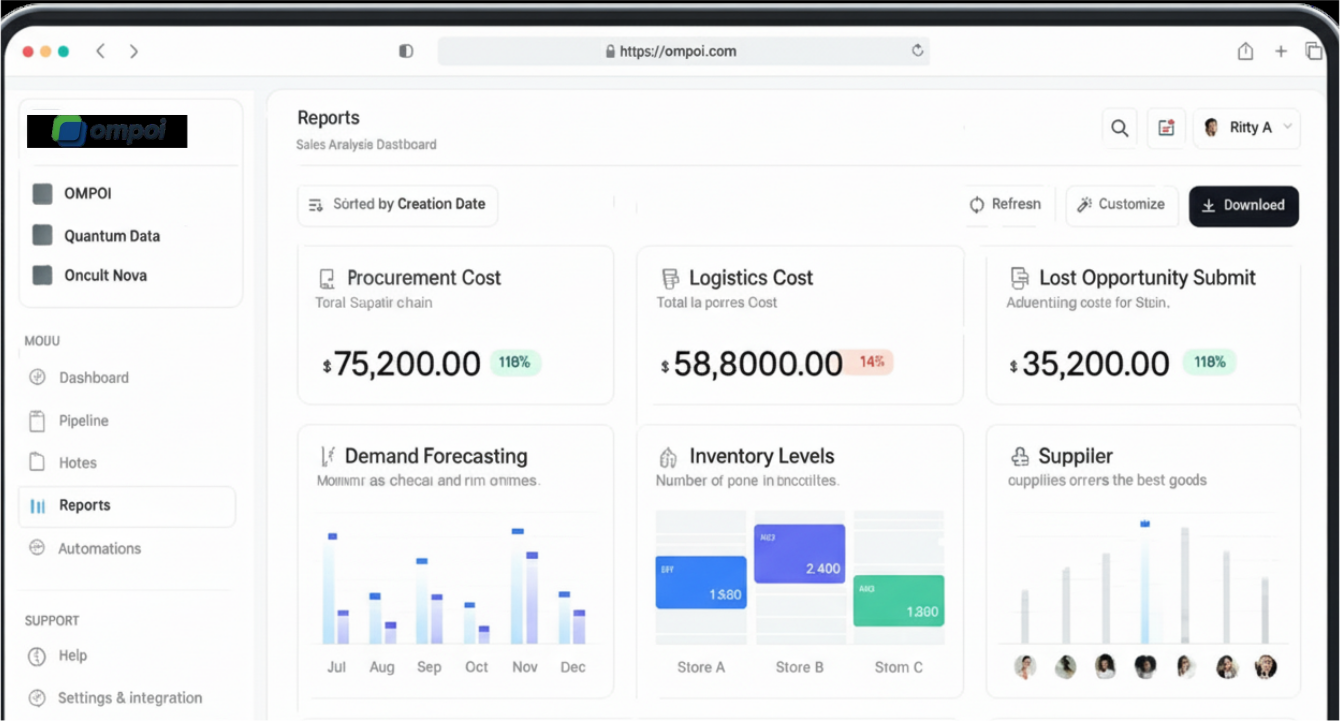
OMPOI's platform integrates demand forecasting with procurement workflows, connecting predictions directly to sourcing decisions. When forecasts indicate increased demand, the system can automatically post requirements to supplier networks, solicit competitive bids, and streamline purchasing—turning predictions into action seamlessly.
New Product Launch Forecasting: Predicting demand for new products without historical sales data challenges traditional forecasting. AI approaches using similar product analogies, market research data, and launch indicators provide reasonable estimates for new product planning.
Promotional Demand Forecasting: Promotions create temporary demand spikes that distort normal patterns. Advanced AI models specifically account for promotional effects, distinguishing between baseline demand and promotional lift. This enables accurate forecasting during promotional periods and clean baseline trend analysis.
Long-Range Strategic Forecasting: Beyond operational short-term forecasts, AI supports strategic long-range predictions identifying emerging trends, market shifts, and growth opportunities. These strategic forecasts inform major business decisions like capacity investments, market entry, and product portfolio strategy.
Emerging capabilities promise even more powerful forecasting including automated machine learning where AI systems automatically select optimal algorithms and tune parameters, real-time collaborative forecasting combining AI predictions with crowdsourced market intelligence, causal AI identifying cause-effect relationships rather than just correlations, and integration with IoT data from smart retail systems providing direct consumption signals.
As these technologies mature, forecasting will become increasingly accurate, automated, and actionable—transforming from periodic planning exercises to continuous, real-time market intelligence driving agile business operations.
Begin your AI forecasting journey by starting with high-impact products where accurate forecasting delivers clear value, collecting and organizing comprehensive historical data, evaluating forecasting platforms and tools suited to your needs and capabilities, implementing pilot forecasts for selected products, measuring results and refining approaches based on learning, and gradually expanding to additional products and applications.
Modern platforms make AI forecasting accessible to businesses of all sizes without requiring data science expertise. Cloud-based forecasting services provide sophisticated algorithms through user-friendly interfaces, democratizing advanced analytics previously available only to large enterprises with specialized teams.
AI-powered demand forecasting represents a paradigm shift from intuition-based guessing to data-driven prediction in agricultural commodity businesses. The combination of advanced algorithms, comprehensive data integration, and continuous learning creates forecasts dramatically more accurate than traditional methods. This accuracy translates directly to business value through optimized inventory, improved procurement, better planning, and enhanced profitability.
While implementing AI forecasting requires initial investment in data, tools, and process changes, the returns far exceed costs for most businesses. In competitive markets where margins are tight and customer expectations are high, forecast accuracy increasingly separates successful businesses from struggling ones.
The question is no longer whether to adopt AI forecasting but how quickly to implement it before competitors gain forecasting advantages that translate to market position. Forward-thinking agricultural businesses are already leveraging AI to see market trends earlier, plan more effectively, and operate more efficiently—advantages that compound over time into sustainable competitive positions.
Ready to leverage AI-powered demand forecasting to optimize your agricultural commodity inventory and procurement? Discover how OMPOI's integrated forecasting capabilities combine advanced analytics with procurement workflows to turn predictions into profitable action.






Reduce costs and improve availability with OMPOI's AI-powered demand forecasting platform.